30.7.10

Climb Every Mountain


Yesterday evening we hauled the kit up to a high spot to get some wide shots of the stunning Yala National Park.


Some of the Sri Lankan team; Lucksman Bandara (park warden), Ajit Kumara (driver), Kalu Murugiesh (driver), Thilanka Ranatunga (naturalist)


Ammonite cameramen; Tom Stephens, Howard Bourne, Martin Dohrn


Leopard spotting

20.7.10

Buffalo Bath Water


Last night we were filming a young female leopard as she approached a small waterhole. Water is starting to become sparse as the drought takes hold and waterholes are become more dispersed here in the south east of Sri Lanka. Due to their strong territoriality leopards regularly drink from their local waterhole, so you can imagine the surprise of our young female when she discovered a huge water buffalo blissfully lying in the muddy remains of her drinking pool.


Far from being deterred she silently approached the buffalo and hid behind a tree until darkness fell. Then as the light failed she crept around behind him and started drinking. All we could see was the buffalo and the leopards tail raised in the air like a flag as she precariously balanced herself to drink from the waterhole. After a few moments the buffalo's eyes shot open as he realised that there was an intrusion into his bath water. Stomping out of the bath and dripping with ooze he chased the leopard around the waterhole and into a tree. Almost blind in the dark the buffalo then paraded around the waterhole, seemingly looking for the leopard before squelching off into the forest. The leopard meanwhile, coolly jumped out of the tree and resumed her drink in peace.

We are returning to the waterhole tonight to see if the leopard returns!

TS

Thermal image of Buffalo and leopard: copyright ammonite

19.7.10

Leopard Spotting

Leopards are famous for their mysterious elusive nature. Obvious when sighted but extremely hard to pick out of the forest due to their dappled camouflage that blends so seamlessly into their surroundings. By day they could be concealed on the forest floor or high up in a tree enjoying a catnap, it’s hard to know where to look. Our challenge is even greater, finding these secretive cats at night and discovering exactly what they are getting up to.

So, with two starlight cameras, one thermal, two spotting vehicles, four night scopes and a small stadiums worth of infrared lights we set out every night to search for them. It may sound excessive but so far we’ve been successful in filming a leopard every night. This would be almost unheard of in Africa where leopards are far less common or dense in their distribution. But this isn’t Africa, we are in one of Asia’s most abundant wildlife areas and filming nocturnal behaviour new to television.

It’s whistling peacocks and chital deer alarm calls that we are listening out for in the forest night. The team are adapting to a whole new ecosystem and discovering leopards are far from predictable. But so far we’ve fortunate in finding them and with another night beckoning let’s hope that our luck continues!

TS

12.7.10

Jungle Driving


It’s 35 degrees with sweltering humidity and we’re deep in the Sri Lankan jungle. Our car is completely blacked out with hardly any visible lights other than the glow of our camera monitors. Infra red lights illuminate the road for our driver as we bounce down the forest track, scanning bushes and clearings for the most elusive of cats. It’s all very covert sounding but I fear our extremely loud car engine may give our presence away. We’re riding in a Ta Ta, one of India’s largest car manufacturers but sadly for us, it’s also the loudest.


Our standard covert approach is something like – Brum Brum Brum, “What’s that!?”, Brum Brum Brum, “STOP THE CAR!!”, screeeetch! “Turn Right”, Brum Brum Brum, “STOP THERE!”, BRUM! “Shhhhhhhhhhh!”


Not exactly a subtle entrance.


Despite the engine noise we’re nearly a week into our trip and every night is providing new insights into this amazing place. We’re looking for leopards as part of a new night series recently commissioned by National Geographic. With the new series comes a new member of the night team, our very own Howard Bourne, cameraman, engineer, kit guru and photographer. This is Howard’s first night assignment but it’s going to be a busy year filming so expect to see more of him and the night car over the next few months.


I’m afraid you may have to wait till next year to see if we’re successful in filming these stunning big cats but check back here for updates.

Tom Stephens

8.7.10

First Day


The component arrived - just in time - but the drama didn't abate. Testing the camera when we were supposed to be ready and packed, we breathed a collective sigh of relief when we got the last bag loaded into the car with just one missing wallet between us.

We were barely late getting on the road and as Roger sped us airportward it was looking good right up until the junction before Heathrow where we joined a massive tailback and spent hours at a standstill, there was a panickey trolley dash for Check-in and Customs and the spiral of solder in my bag really did look quite a lot like a bomb fuse in the x-ray machine.


We have now arrived at Yala and today is the day we set up the vehicles; special filming cages and rails have been fitted to a Tata and a Jeep and we are getting busy with cardboard, foam and gaffer tape constructing super-lo-tech housings for our super-hi-tech equipment

5.7.10

All Packed And Ready To Go


Visas? - check

Vaccinations? - check

Filming Permits? - check

Flights booked and paid for? - check

Equipment? - 20 cases already waiting in Columbo

Starlight Camera? - ????????

It's been a buttock-clenching month, the final component needed to mend our Starlight Camera was sent out to us a couple of weeks ago - and got lost in transit, every day since, we've eagerly awaited it's arrival.

With the filming dates fixed to coincide with favorable moons and the best chance of good weather we need to go tomorrow.

As I write this, a Camera Boy is running back from Europe clutching a new part - will he get it back here and in the camera by tomorrow morning?

7.6.10

Ammonite’s Man In Colombo

Just a week ago I was in huddled under canvas enjoying the bank holiday on the bright but chilly Devon coastline. A few days and a couple of quick decisions later, I found myself on malaria tablets and in the middle of the IIFA Bollywood film awards in Colombo.

It has been a hectic and sleepless couple of days but after a frankly terrifying six-hour drive through Sri Lanka’s stunning interior (overtaking buses and elephants on low-loaders), I finally made it to the wild south coast. Crashing surf and thick jungle greeted me along with monitor lizards and cobras spilling out of the forest and onto my hotel room terrace.

I’m in the depths of the Sri Lankan jungle on a week-long recce for a forth-coming Ammonite project (watch this space for details!). However I would be giving little away to say that I’ve visited one of Sri Lanka’s most pristine wildlife areas where I encountered a totally different ecosystem than I’ve become familiar with in Africa. Water buffalo appear like submarines from waterholes whilst smiling crocodiles line the banks. Lazy leopards hang in the trees contemptibly looking at the clambering vehicles surrounding them. It’s a great place.

Whilst I’m here I’ve been working with a fantastic local team who’ve been trialling a rather unique remote camera. Always keen on new technology at Ammonite I couldn’t help myself in lending a hand with the trial run this morning. Attaching a tiny HD camera in an underwater housing (that can apparently survive being run over) we fixed the camera to a kids remote control car and parked it in front of a herd of elephants. I’m not sure if being squashed by an elephant is in the manufactures warranty but fortunately we’ve not had to find out yet as the elephants took a curious interest before moving on without crushing our new toy. I’ve attached what can only be described as a mongoose’s eye view of an elephant with this post.

So it’s back to the office on Wednesday and leaving the warmth of Sri Lanka behind, look out for our posts over the summer as the Ammonite crew return to the jungle on our latest assignment.

Tom Stephens

28.5.10

Bourne Goes Badgering


Howard Bourne has been out filming badger activity at night. Here's a clip, just in case you ever doubted the cuteness of either Howard or the Badgers.

... Erm click on the movie to watch in Youtube if you'd like to see the whole frame

18.5.10

Dirt Box Ants


Two days on, the dirt box ants have put most of the soil where they want it and have created a wonderful array of tunnels, chambers, trash heaps and new fungus gardens. They are adapting their deep urge to dig within the confines of a few plastic boxes and a couple of plastic tubes - and seem very happy. When offered fresh rose leaves, they immediately set about cutting them into little semi-circles before carting them off to the fungus gardens (see image). There, the leaves are cut into yet smaller semi circles, dosed with a bit of anal secrection, chewed a bit and applied to the ever growing mass of fungal hyphae.

The details of this process are only now being worked out. Michael Poulson, Cameron Currie and the team at the Currie lab are discovering that the ants are manipulating various kinds of bacteria to aid the fungus and increase its nutritional value in a complex 4 (or more) way symbiosis.

15.5.10

Leaf Cutter Lab Ants

After an arduous journey consisting of at least 20 different queues, three different airports, and a bomb ‘scare’ (nobody seemed very scared) we finally arrived in Madison Wisconsin. We’re here at the Cameron Currie lab to film the internals of leaf cutter nests that would be impossible to see in the wild without digging up the whole enormous colony and destroying it. Luckily for us, leafcutters are easily kept in captivity and are the focus of much research on how exactly they manage their crops of cultivated fungus.

The ants here live mostly in plastic boxes of various sizes, and their beautiful sponge-like fungus gardens are easy to see. (Alex Wild was here a couple of weeks ago and took these pictures


As we need to film these ants in a more natural situation, we’ve given them some real dirt to play with. They haven’t seen soil since they were collected from Costa Rica a couple of years ago, and they are loving it. Yesterday morning, they started excavating some new chambers for fungus gardens, and we’ve managed to film some close up digging, and spectacular tracking shots of them carrying the soil down tunnels to the soil dump.

12.5.10

...And They're Off!


Howard Bourne, William Dohrn and Martin Dohrn are on their way to Wisconsin, USA to film leafcutter ants.

Dispatches arriving shortly

7.5.10

Ant Intelligence


Not content with simply going around the world to film diverse colonies of ants for The Incredible Film About Ants (title tbc). We have now travelled right across Bristol to visit Professor Nigel Franks, a world expert on social insect behaviour.


The ant's sophisticated communication and decision-making systems are key to their global success, Professor Franks has a colony of rock ants each with a tiny chip on their back, participants in an experiment demonstrating how ants make choices between prospective nesting sites more details of this work here. We had a busy day filming the ants as they moved around the set activating laser-controlled doors on their way to different sites, we also interviewed Professor Franks for the film.

We have two more filming trips to make before we can hand the material to the editor, stay tuned...


Photos
Howard Bourne filming in the lab with Professor Franks (Nadége Laici)
Chipped rock ants - Temnothorax albipennis (Ammonite photography team)

1.5.10

Hangers on


The mystery skin disease turned out to be 'cutaneous larva migrans', a kind of worm that burrows into the skin and intends to enter the lungs where it lays eggs, which get coughed up and swallowed - to pass out in the animals faeces. Thankfully in humans this hanger on lacks the necessary enzymes to penetrate the body, and can only meander aimlessly just under the skin until it runs out of motivation. It can be treated with a drug called Albendazole.

The army ants have their own hangers on. In the photo, what appears to be an ant is in fact a small beetle, dressed up to look like an army ant, which lives its entire life in the mobile ant colony, feeding on the plentiful prey that the army ants bring back to camp.

26.4.10

The Cost of Good Images


Frankencam has been designed to make filming small things on the forest floor easy. Taking still images is a whole other problem. If you want to get striking photos of ants, you may well need to lie down on the ground with them. In the tropics, this behaviour carries a risk - in this case, some kind of burrowing animal (see photo) - possibly a fly larva, possibly a very large kind of mite (photo dimensions about 40mmx35mm). If anyone has an idea what it could be, we’d love to know.

Argentine Ants


Our last shoot in Spain focussed on the Argentine ant invasion of the world. Scientists are only just unravelling the causes of their incredible success at colonising Europe, North America, Hawaii, Australia, New Zealand and many more. It turns out that the bulk of these ants form one enormous super colony of ants that will always welcome each other if introduced. There are other supercolonies, one from Catalonia in Spain, which will immediately attack ants from different super colonies, and fight to the death. This photo shows one ant from the main supercolony snipping the leg of an ant from the Catalan supercolony, while its own limbs are severed in the same way.

Army Ant Myth


People love to write and believe sensationalist drivel about army ants. The internet is full of made-up ‘facts’ that suggest they can eat chickens, pigs, even people, that everything living flees from their advance etc etc. In fact, the best known species of army ant, Eciton burchellii doesn’t eat meat, never touches carrion, and a swarm will turn and run from a stamped foot or human breath. Its behaviour is still utterly extraordinary, and is an ant filmmakers dream - because it lives most of its life in the open where it can be seen. In this photo, a coordinated team of four ants cooperate to carry a centipede carcass.

There are other species of army ant that are much less pleasant to work with. Labidus and Dorylus are two genera of more aggressive ants that will attack livestock if it is caged or tied. But even for them, stripping a mouse to the bone would take a day. Disposing of a chicken is entirely out of their league.

Bullet Ant Myth


This is one of the largest species of ant in the world, about 25mm long, here carrying a drop of liquid back to its nest. Apparently it’s called the bullet ant because it is said that when it stings you, you feel as if you’ve been shot. Personally, I’d say it’s more like a bee sting, only a bit sharper, and nowhere near as painful as the sting of the harvester ant (Pogonomyrmex), one species of which has been identified as possessing the most potent venom of any animal so far tested.

18.4.10

Airport Drama


The message to Iceland had been
'Please send CASH'

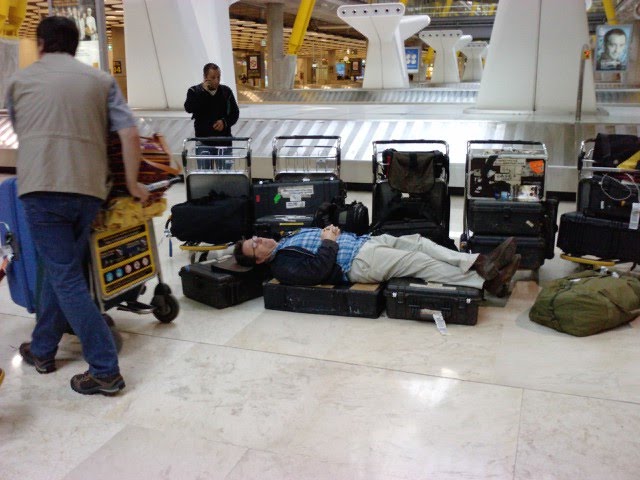
meanwhile our ant-filming crew are stuck in Madrid airport waiting for the rest of the cases to turn up - we have a lot of baggage

11.4.10

Santa Rosa Dry Forest trees


Costa Rica wet and dry

The dry season is the best time of year to visit Santa Rosa. Because of the extreme conditions (rain for 6 months, no rain at all for 6 months) the trees here have developed some spectacular adaptations to the climate. By January, most of the trees have lost all of their leaves, and the place looks almost like a northerm deciduous forest in the winter. But it’s 40 degrees in the shade. Extreme thorns are a regular features (see photo) while other trees have bark that can continue to photosynthesise through the dryest weather, long after the tree has become leafless (see photo).

100 miles away, on the other side of the mountains which divide Costa Rica, is La Selva research station, the place that caused the fungal foot episode. Here, the habitat is rain forest in the truest sense. At the moment, it rains for an hour, then we get no rain at all for an hour. Filming is going slowly. Today the crew are waiting out the weather beneath a canopy created by huge 60 metre trees, notably ceiba, surrounded by ferns of every description, and the wild relatives of typical office pot plants, ficus, palms, cheese plants etc. (pics to follow)

The Director

Deer chases vampire in Costa Rica

9.4.10

It's Getting Competitive


The Director has sent us this photo of an arm that has reacted badly to the bites of tick larvae. He feels that this spectacle deserves more sympathy than Stephen's fungal foot - should we turn this into a proper competition, awarding a medal to the most appalling fate suffered by wildlife film-makers?

8.4.10

Vampires In The Forest

While the ant crew are filming at La Selva, I’m spending a few days in another part of Costa Rica - the extraordinary Pacific dry forest of Guanacaste conservation area* - investigating the possibility of another film (that would be our fourth in this area).

This forest type was once found along the entire Central American Pacific coast, and now exists only as a few fragments, this being probably the largest.

At this time of year, it’s bone dry, few of the trees have leaves, and yet there are still typical rainforest animals living here, parrots, tapirs, jaguars, three species of monkey - and vampire bats.

Last night, testing the thermal camera allowed us to watch as vampires landed near white tailed deer, and hop towards them. The deer knew exactly what was going on, and chased the vampires away.

The Director

* more here

4.4.10

Welly Rot


I have cycled more miles in the last week than over the course of the entire year. This isn’t part of some new fitness program; it’s all because of ants.

My recent bout of pedalling is taking place in jungle – Costa Rican jungle. We are at La Selva, a small reserve run by the Organization for Tropical Studies. They had the foresight to make this beautiful patch of rainforest accessible to everyone, and that means broad cement trails that link together a good chunk of its 1600 hectares of protected land. For a film crew it’s a great help, particularly when you have 21 cases of heavy film equipment to lug through the forest. We can rent tricycles with large front-loaded luggage carriers to move our equipment to the best areas for ant action. In the last week we have witnessed two army ant raids, filmed leaf-cutter ants chomping their way through hundreds of cocoa leaves and assembled a 20-foot crane in the forest to shoot a high-angle view of a large leaf-cutter ants’ nest.

But I am beginning to feel rotten – quite literally. My left foot has developed a fungal infection from days spent in sweaty rubber boots. Why rubber boots? There are plenty of snakes in the forest that could kill with a single bite not to mention the awesome stinging power of hundreds of thousand of marching army ants; boots are a line of defence against the dangerous creatures of the jungles but unfortunately the pay-off seems to be foot rot! I think, all things considered, I’ll stick with wearing the boots and take my chances with my rotting left foot.

Stephen Dunleavy

31.3.10

And They're Off

Howard Bourne, Alastair McEwan and Stephen Donleavy packed their several dozen bags and set off to Costa Rica for the next stage of ant filming.


We are already getting reports of gruesome fungal attacks


news from the front will be arriving soon!

24.3.10

John Lynch Voices Our Amazing Lion Film


The very handsome John Lynch came to Wounded Buffalo studios in Bristol today so that Ben Peace* could record him doing the voiceover for The Amazing Lion Film.

His gorgeous Irish voice works wonderfully and suddenly this film is looking really real.

*Ben is planning to name his next son Warren

11.3.10

What Happens Next?

Sorry about the long silence, we've had our heads buried in post-production for the last umpty squillion weeks, finally ... finally the picture is locked and the Man Upstairs says he likes it. We're now doing script tweaks, sound stuff and grading. The Astonishing Lion Movie (title to be confirmed) will be on your screens in the UK and Stateside in September. We'll tell you more and put trailers up when the Man Upstairs says we can.

We are also preparing the next filming expedition for the Ant Film which sets off just before Easter to Costa Rica so expect this screen to flicker back into life soon.

Thank you for your patience

4.1.10

What We See In The Cutting Room


A bit grisly - but that's life!

Happy 2010 everyone

19.12.09

Crew Christmas Party


In order to record the proceedings we first had to show Fiona how to use a camera, she then told rude jokes to  Nadége, Tom and Steve - the only publishable group shot can be seen on our home page


30.11.09

Sad News

The last week has been pretty frantic, getting all the material ready for the edit (editor starts today) as well as getting ready for a trip to Washington DC to account for our time in the Mara.

We hear that the rain hasn’t stopped there yet, which means we got out in the nick of time. Black cotton soil can swallow cars whole if it’s wet enough.

Sad news about the ‘Lazy Girls’ though. These are the two lioness and three cubs we filmed at crucial times for our film. We called them the Lazy Girls not because they seemed in any way lazy, but because of their presumed association with the Lazy Boys (who truly are lazy). The first night we met the Lazy Girls, they were trapped in a lugga with their cubs surrounded by hyenas. They roared repeatedly for support, and the Lazy Boys roared back – but didn’t come and help.

Last week we heard that that the smallest of the three Lazy Girl cubs has been killed, and her mother is pretty beaten up – either by the Motorogi females who are not happy with the Lazy Girls trying to raise cubs in such close proximity to their own families – or by hyenas. Either way, the Lazy Boys failed to be there to prevent this loss. Let’s hope the last two cubs make it through. The Mara needs them.